

The Melaka snap election was held in November 2021 due to the ongoing political crisis. As physical gatherings were restricted to curb the spread of COVID-19, political campaigns were conducted online. Pusat KOMAS collaborated with Zanroo Malaysia to monitor social media conversations during the Melaka state elections which took place from 1 to 22 November 2021. Public conversations, statements and actions of politicians and political parties were monitored and documented to see whether there were any signs of racial and religious politics played out on social media.
General Findings of the Social-Media Monitoring Project
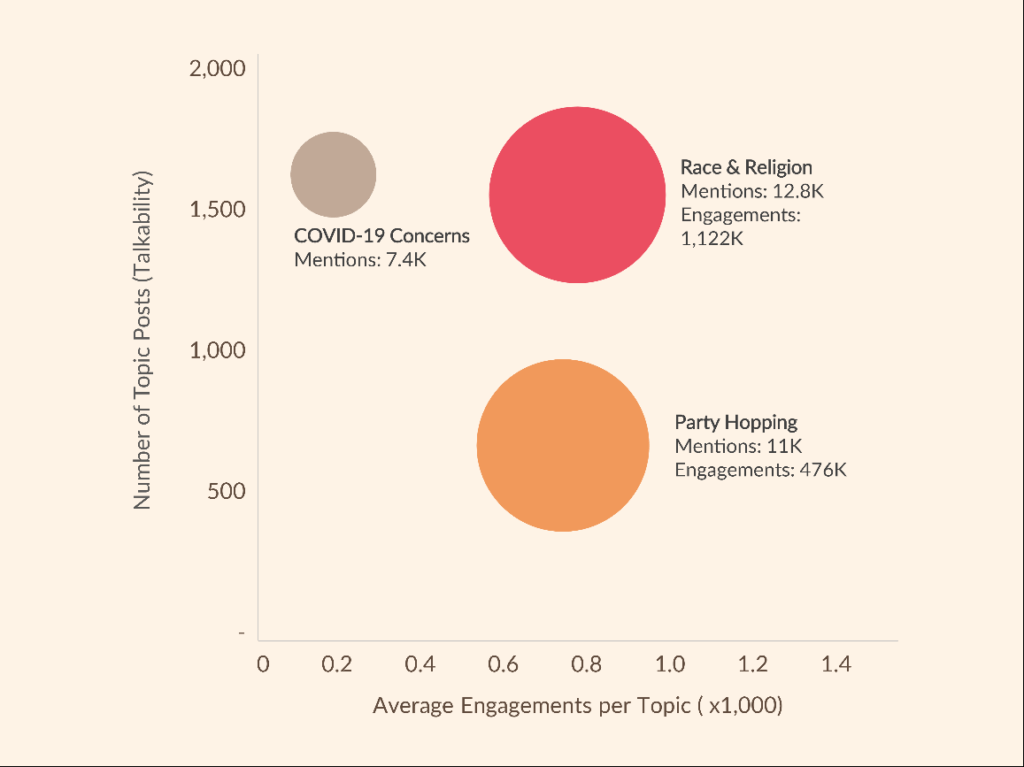
Several conversational topics were identified on social media during the Melaka state elections. Topics related to (1) Party Hopping, (2) COVID-19 and (3) Race and Religion were found to be the key topics that surfaced during the elections, demonstrating high impact scores (high talkability [1] and average engagement per topic [2]). In this sense, posts with high impact scores would mean that conversations on this topic were initiated in social media and reacted (by liking, sharing, commenting, etc.) when it was seen.
- [1] Talkability: Number of original posts about a specific topic (How likely did a member of the public initiate a conversation about a topic)
- [2] Average Engagement Per Topic: The number of engagements in a particular topic over the number of original postings in that topic (How likely did members of the public interact with the topic)
- Party Hopping
Party Hopping was found to be one of the key topics that were highlighted during the state elections as the state election was triggered by elected representatives who decided to switch their political allegiance. Malaysians were found to express their views and opinions in social media about this topic. Party Hopping ranked the lowest in terms of talkability among the three conversation topics, but high in average engagements per topic.
- COVID-19
Malaysians were found to express their concerns over the COVID-19 pandemic during the Melaka state elections as the previously held Sabah state elections had compromised COVID-19 containment efforts, which has caused the infection numbers to spiral out of control. The public had expressed fear that a similar situation would happen because of the Melaka state elections. This topic ranked the highest in terms of talkability but ranked the lowest on average engagement per topic.
- Race and Religion
Topics related to race and religion were also found to be trending in social media during the Melaka state elections. Though not the highest in talkability and average engagement per topic, this topic scored relatively high in both talkability and average engagement per topic, demonstrating a high impact factor.
Although topics such as Party Hopping, COVID-19 and Race and Religion were found to populate the conversation in social media during the Melaka state elections, it is worrying that Race and Religion yielded a high impact factor, suggesting that the conversation on topics related to Race and Religion garnered high responses and generated much conversation among the general public when compared to other topics such as Party Hopping and COVID-19.
Race and Religion on Social Media
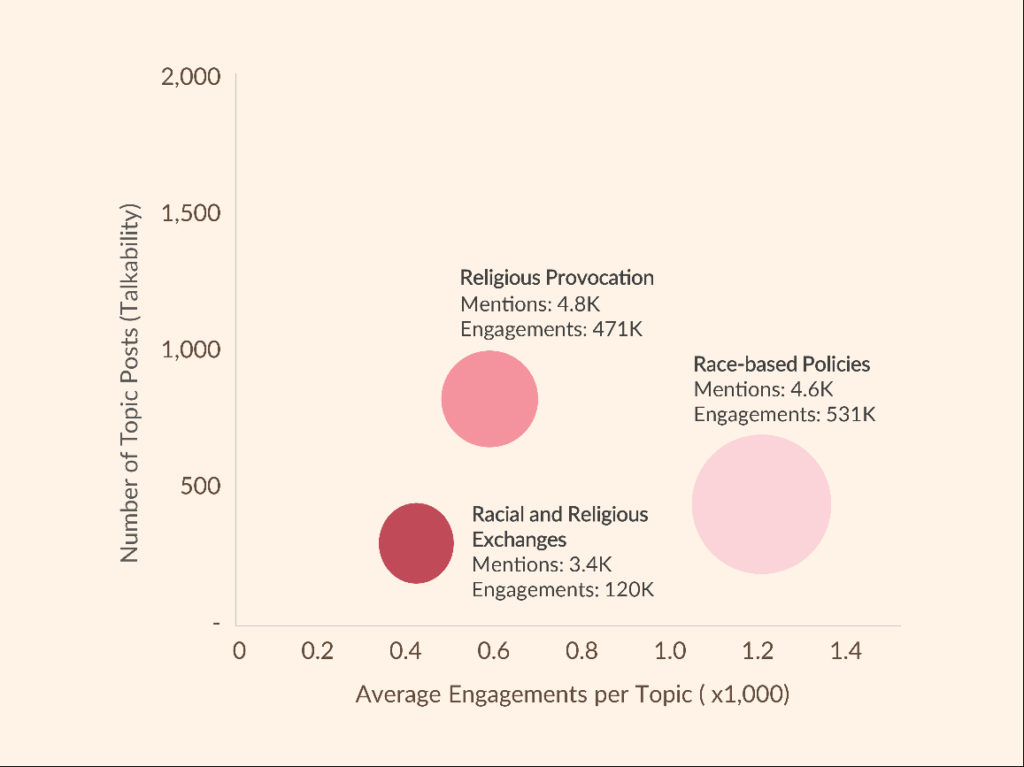
Specifically, we examined conversational topics related to race and religion and identified the following topics (1) Religious Provocation, (2) Race-based Policies and (3) Racial and Religious Exchanges to be the key conversational topics under this category. Similarly, the impact scores of these topics were also examined and demonstrated in the figure below.
List of keywords used for monitoring (not exhaustive):
- UMNO
- Bersatu
- DAP
- PAS
- PKR
- Gerakan
- Pakatan Harapan / PH
- Barisan Nasional / BN
- Amanah
- MIC
- MCA
- IMAN
- Perikatan Nasional / PN
- Cina
- Melayu
- India
- Pendatang
- Article 153 / Artikel 153
- Agama
- Islam
- Sekolah vernakular
- Bumi / Bumiputera
- Hak istimewa
- Tanah (Tanah Melayu / Tanah Asli / Tanah Asal)
- Arak
- Katak
- Judi
- Perpaduan
- Keharmonian / Harmoni
- Kepelbagaian
- Hudud
- RUU355
- Tongsan
- Keling
- Ummah
- Muafakat Nasional
- Bangsa / Kaum
- Hawau
- Religious Provocation
Political campaigns based on religion such as #IslamMenyatukanUmmah to promote Muslim unification and the sensationalisation of issues into religious issues such as calling for the ban of the whiskey brand name ‘Timah’, the closure of 4D shops in Kedah and the liquor ban in several states had yielded high talkability and moderate average engagement per topic during the Melaka state elections.
- Race-based Policies
Conversations concerning policies that safeguards or protects the interest of one’s ethnic group were also another topic which yielded a high impact factor. Specifically, this topic ranked moderately in talkability but the highest in average engagement per topic. Topics related to bumiputera-oriented policies (e.g., quota system) and education policies related to the national language (e.g., Unified Examination Certificate, vernacular schools) were racialised and used during the Melaka state elections.
- Racial and Religious Exchanges
The general public were also found to engage in racial and religious conversations in social media during the state elections. Some messages were anti-racist where members of the public called out racist or racially discriminatory behaviour of politicians and political parties. Others were explicitly racist, containing racist slurs and speaking in a hostile manner about other races. A small number of messages were related to fear mongering, where members of the public were not explicitly attacking or insulting a particular race, but suggesting that a particular race was a threat to their own and calling for their own race to beware of said threat. This topic ranked the lowest in terms of talkability and average engagement per topic.
Our findings suggest that most conversations related to race and religion originated from politicians and/or their political party. During the campaigning period, the calls for the banning of the whiskey brand “Timah” and the closure of 4D shops in Kedah were initiated by the politicians themselves. The timing when these topics were raised was concerning as they were only raised during the electoral period, which suggests that these issues were initiated to stir voters’ emotions and to influence their voting decision. This was reflected in the conversations that were found on social media where people from different religious groups began debating with one another over the matter. From this, it can be inferred that social media conversations on race and religion are driven by politicians’ actions and by news media outlets which report incidents in a politicised and sensationalised manner. When these matters are politicised and sensationalised, heated arguments and debates on social media can easily break out, severing the already weakened social fabric that binds all Malaysians together.
Political Party Communication Strategies
We also examined the communication strategies of the main political coalitions and their component parties during the Melaka state elections. Key postings from the party’s official channels and their key spokespersons (e.g., party leaders) were monitored and selected for the analysis. Four broad categories were identified in the political party communication strategies:
- Messages related to Politics
Posts or comments that mention political issues and attacks between parties (e.g., BN Leaders are all kleptocrats, PH is hungry for power, the collaboration between PAS and Bersatu) are categorised under this category.
- Messages related to Economy
Posts or comments that include a mention of economic-related matters (e.g., Budget 2022, Tax Reduction, return on investment for certain projects/initiative) are categorised under Economy.
- Messages related to Race & Religion
Posts or comments that mentioned any ethnic group (e.g., Melayu, Chinese, etc.) and religion (e.g., Islam, Hindu, etc.) are categorised under Race & Religion. Any post or comment which contained mentions of ethnicity and religion are included in this category, regardless of whether the post or comment made a general reference to ethnicity or religion, was racially or religiously provocative or opposed racism.
Barisan Nasional (BN)
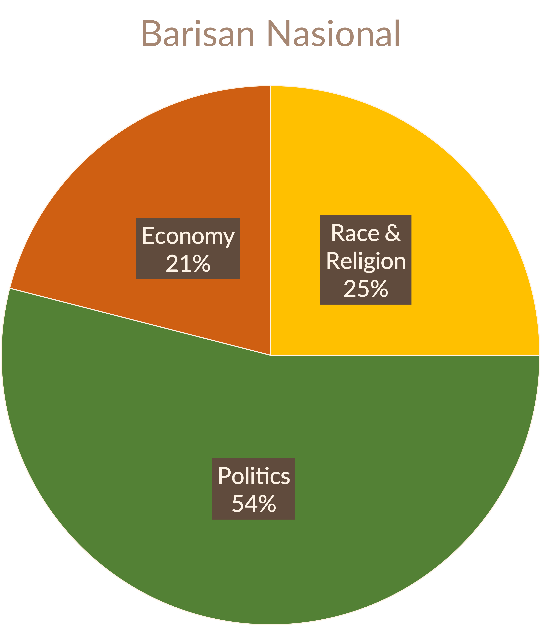
The largest portion of messages from BN fell under the Politics theme (54%). From the political standpoint, several of BN’s postings were targeted on other parties such as PH’s attitude towards party hoppers, as well as BERSATU, in its reaction to UMNO refusing to work with them. Other messages revolved around their manifesto and their local campaign progress. Twenty-one percent (21%) of messages from BN were concerned with the Economy such as GDP growth and the Melaka gateway project. In fact, one of the key spokespersons of BN highlighted issues such as GDP growth and Melaka Gateway project as prove of incompetence of PH. Race and Religion accounted for twenty-five percent (25%) of BN’s communication strategy, where most of the messages were used to attack PH for being hypocritical in promoting a Malaysia for all Malaysians. For instance, BN’s spokesperson claimed that PH was the one who was trying to politicise the “Timah” issue to create controversy against the government, despite them being the mastermind behind the issue (claiming that Timah was given approval during PH administration). Some messages were also linked to PAS and Muafakat Nasional. They claimed that this is in line with UMNO’s policy as they have not neglected the rights and benefits of other races and religions and to treat everyone with respect.
Pakatan Harapan (PH)
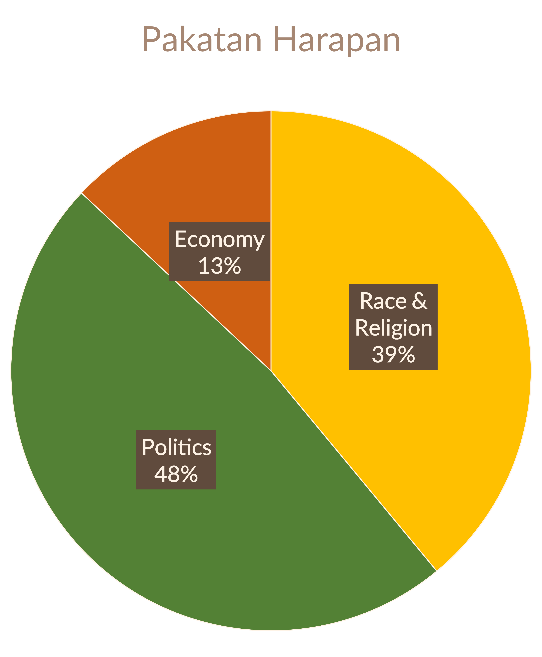
The largest portion of messages from PH also fell under the Politics theme (48%). The coalition promoted the former Chief Minister as the better candidate to govern the state based on previous track record via discussions and policy suggestions on issues like floods. The second largest portion of messages from PH concerned Race and Religion (39%). Most of PH’s messages are focused on condemning BN, UMNO and PN by claiming that these parties are corrupted parties that would “rule with divisiveness and double-standards while using their resources to enrich their cronies. They also mentioned that BN and PN’s response to the Timah issue shows that these parties are neglecting the rights and benefits of the non-bumiputera, reiterating that PH is there to create a Malaysia that is not ruled by racial policies. The remainder of the messages were related to the Economy (13%) which highlighted previous achievements such as demolishing GST and securing Tabung Haji, basing it on their previous track record governing the state.
Perikatan Nasional (PN)
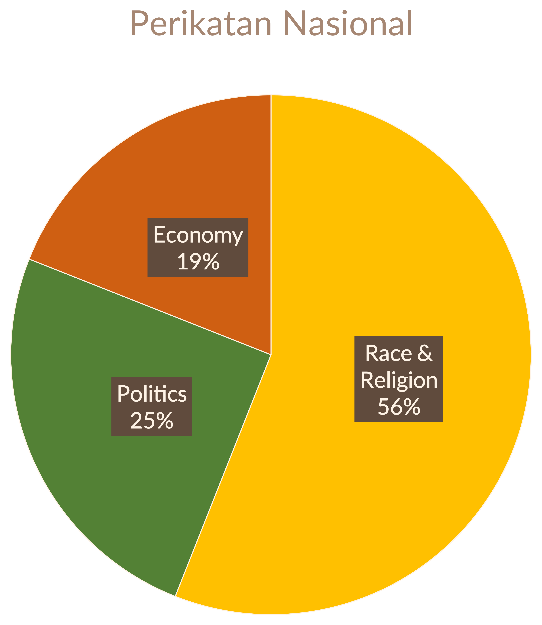
The largest portion of messages from PN fell under Race and Religion (56%). The coalition promoted candidates based on religious factors (i.e., morality standards of a particular religion) and called for unity of the religious community. Key messages by the coalition partner, PAS were mostly in “Penyatuan Ummah”, which is targeted at the Muslim community. By holding strong to Islamic values and morality, PAS is promoting their candidates as the right choice to be part of the state government. Additionally, the issue of Timah and Kedah 4D ban were part of the communication strategy by PAS, where PAS was defending their actions by claiming that both alcohol and gambling are prohibited by other religions. The second largest portion of messages from PN were about Politics (25%). Collaboration between two component parties as well as the political strategy of nominating a female candidate for the position of Chief Minister to gain voters’ attention. The remaining messages were related to the Economy (19%) in terms of recovery of the national economy after the pandemic. One of the major calls by the PN coalition is on creating a stable and clean state government in Melaka.
Overview of Mentions of Race and Religion according to Coalition
Our findings revealed that race and religion constitute a huge percentage of the three coalition communication strategies in the Melaka state elections. Comparing the number of mentions related to race and religion contributed by political parties, BN ranked the highest on the topic of race (particularly on race-based policies), pushing the narrative of bumiputera rights and privileges. Additionally, they advocated for the need to uphold the national language. Meanwhile, PH’s agenda focused on promoting an inclusive policy for all Malaysians regardless of race, religion and background. PH also criticised BN for the racial split and crony culture. Meanwhile, PN scored the highest of mentions related to religion due to their campaign slogan of Islam Menyatukan Ummah. They were also strong advocates for the closure of 4D shops and the change of the whiskey brand name “Timah”.
The use of race and religion by coalition parties, particularly to champion and defend their own ethnicity and religion, appears to be an important tool for coalition parties to appeal to voters of a particular race or religion. The actions from these parties may have enduring impacts on race relations as shown in the impact scores of race and religion during the Melaka state elections. Heated arguments and debates related to race and religion were found to be prevalent in social media due to the messages conveyed by political parties. Though there were coalitions who were banking on messages of unity, the ongoing exchanges between coalition parties accusing one another of being racist may become more prominent, diluting the message conveyed. It is important to note that if race and religion continue to be used by coalition parties in upcoming elections, it may further exacerbate interethnic tension and hinder nation-building exercises.
Implications for Future Elections
Noting the findings from this social media monitoring project, it is imperative that for our country to move forward and to build a Malaysia for all Malaysians, politicians and political parties should take immediate steps to move away from the use of race and religion in politics. They should pursue policy actions that truly benefit constituents of all races and religions and not favour a particular ethnic group, as it may create uneasiness and unhappiness among other ethnic groups as they are not provided an equal opportunity. Coalition parties such as Barisan Nasional and Perikatan Nasional should stop playing the race and religion card in their campaigns.
It is ironic that on one hand they are calling for a united Malaysia through the #KeluargaMalaysia campaign and the recent launch of the National Unity Blueprint and National Unity Action Plan 2021 – 2030, while on the other hand, they are campaigning for a particular ethnic and religious group. Therefore, we call upon all politicians and political parties to practice what they preach and not backtrack on the policies that they introduce at the federal level. As elected representatives, they have a responsibility for all Malaysian citizens and not a particular ethnic and religious group.
We also call upon voters to hold their elected representatives accountable. As voters, we have the responsibility to carefully scrutinise our electoral candidates before voting for them. We need to choose wisely and denounce politicians and political parties that exploit race and religion for their own benefit. It is hoped that there will be a drop in the use of race and religion in the upcoming Johor elections and future elections.
Pusat KOMAS alongside with Zanroo Malaysia will continue conducting our social media monitoring project for the upcoming Johor state elections. For the Johor state elections, we will focus on the communication strategies of political parties related to race and religion, and collect quantifiable evidence on whether political parties and influencers maintain their current focus and pattern of political campaigns that involve race and religion. We look forward to improvements in Malaysian politics where people of all races and religions are free from exploitation by politicians and treated fairly in the country they are proud to call home.