
Why the Negara-Ku Movement is a Must, Now
In his article ‘Why form Negara-Ku?’ which appeared in The Malaysia Insider on 14th July, 2014, Ahmad Hafidz Baharom has given our Negara-Ku Movement the opportunity to address several issues.
We hope thus to be able to put to rest niggling doubts and misconceptions that not just he but others too might have, so we can move forward to deal with the imperatives of the day.
Negara-Ku – why another NGO?
Under the notion that Negara-Ku is an NGO, Hafidz asks why another NGO needs to be formed when there are already so many NGOs which have forged a coalition to address national unity.
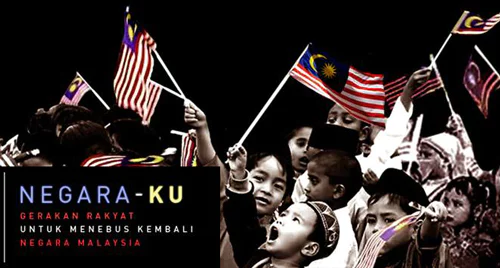
Firstly, we need to correct this misconception. Negara-Ku is not an NGO but a people’s movement initiated by a coalition of NGOs.
Negara-Ku is a spirit that yearns for the betterment of this nation. It desires to honour the agreements made by our forefathers birthed out of mutual trust and for the benefit of all. Because it is a spirit, there is no such thing as ‘membership’. Those who, like us, want to go back to the very roots of this nation – the Federal Constitution, the Malaysia Agreement and the Rukun Negara – have already embraced that very spirit.
Secondly, we are not aware of another coalition forged to pursue the very objectives of Negara-Ku. If indeed there is, we look forward to working together with it.
Why Negara-Ku? Why not GBM ?
Hafidz contends that I, as the Negara-Ku steering committee chairman, had admitted that the NGOs within Negara-Ku had worked together under the already-established Gabungan Bertindak Malaysia (GBM), formed in 2011 to champion a better Malaysia. He asks why everyone can’t just group together under GBM to push forward the agenda of national unity.
They can’t because GBM is a coalition with a series of objectives and Negara-Ku is a people’s movement to reclaim the nation and to give her people hope. It is not a question of whether or not GBM has failed. It is a question of what is being spearheaded as being of paramount importance. GBM, on its part, for now at least, serves as the Secretariat of N-K, a movement, and not an NGO.
As I had explained previously ( Zaid: Malaysians will embrace Negara-Ku ), Negara-Ku was conceived jointly by some concerned activists from various diverse groups. It was the coming together of concerned citizens from NGOs with diverse interests but with a shared concern about the current trajectory of the nation.
It is important to note that both bodies do not have the same groups within them. There are 24 NGOs under the GBM umbrella. There are, to date, 68 NGOs that are a part of Negara-Ku.
We would like to stress that contrary to Hafidz’s statement – “And having read the Negara-Ku charter which is not undersigned by the 68 organisations just yet…” – by the date of publication of his opinion, these 68 organisations had indeed already endorsed the Negara-Ku charter.
A good question to pose would be why more NGOs have been drawn to the N-K vision and mission. For us, it is clearly because of the indecent ‘Now’ in our country’s history.
Now, more than ever before, racist tongues and extremist actions go unbridled.
Now, more than ever before, the Federal Constitution, the Malaysia Agreement and the Rukun Negara – the instruments that hold this nation and its people together – are ignored.
Now, no political power, no police force, no judiciary seems desirous of stemming the overflow of violence, virulence and vice.
For us, the Negara-Ku movement is a must, now.
Negara-Ku’s not ‘nice start to unity talks’ ?
It is unfortunate that Hafidz’s reading of the Negara-Ku charter, in particular its aspiration ” to resist all forms of intolerance, bigotry, hatred, extremism, and violence ” should cause him to say so simplistically that the movement through its charter is being “intolerant, bigoted and clearly extremist against the state, political parties and their affiliates”.
To him, the movement has started off its so-called “unity” run on the basis that the government and all related parties have failed and “That’s a nice start to unity talks, isn’t it?”
Hafidz needs to go no further than the Charter’s ‘WHY’ and ‘WHAT’ to get his answer, as follows :
WHY?On a daily basis, we are confronted with serious challenges that have begun to undermine the very foundations of our Nation. The peace and harmony of our multi-ethnic, multi-faith and multicultural society are under threat. Ethnocentric and race-based politics and communally-minded politicians continue to derail the process of inclusive nation building and the formation of a Bangsa Malaysia national identity. Importantly, religion is now increasingly used as a main marker of identity, and as a boundary maintenance mechanism to polarise the people. There are political parties and their affiliates that are not focused on nation building, rather on building their respective power bases. These parties on both sides of the divide pursue their agenda that are transactional and short-term, not transformational and long-term. |
WHAT?We believe the majority of the People want to end this brand of divisive ethno-religious politics. We want to take ownership, fully cognisant, that Malaysia is a nation where her people are inextricably bound by a shared history, commonweal, and destiny. We have to act before our society descends into the abyss of instability…. |
Hence, our question to Hafidz is: Please identify which part of the Charter reproduced above does not accurately depict what is happening in the country today. Negara-Ku would be an irrelevant entity today had the political leadership on both sides of the divide prevented, disallowed, arrested what we see happening unabated practically every day.
Negara-Ku’s way forward for hope and healing?
Yes, we agree with Hafidz that healing the nation and restoring hope would need to include the state, political parties and their affiliates. Note the following in our Charter:
3. To strive for a socially inclusive society;
It is erroneous on his part to suggest that we may choose to remain within ourselves. We certainly do intend to reach out to all quarters. In this regard, we hope he will, at the appropriate time, urge those parties to respond positively to our overtures.
Negara-Ku: only old war horses? no new blood?
A final issue Hafidz raises is the seeming absence of new blood – new leaders, fresh faces and the next generation – in the Negara-Ku movement. From his standpoint, it clearly looks like the ones leading – Ambiga and Pak Samad – are just forming a Bersih Veteran’s Club.
The old war horses in Negara-Ku urge Hafidz and his young colleagues to come in and take leading positions so that we, the familiar faces, may be put out to pasture. Indeed, we look forward to this. It is because the younger generation has been inactive in stepping forward to check the direction the nation is seemingly headed towards that we veterans took it upon ourselves to do it.
Negara-Ku
This is our nation. The length and breadth of it belongs to all of us. What our Federal Constitution, Malaysia Agreement, Rukun Negara have put together, let no man tear asunder. Our pledge is that you and I have a rightful place here, under the Malaysian sun. So be a part of Negara-Ku.
Zaid Kamaruddin
Chairman, Steering Committee
Negara-Ku