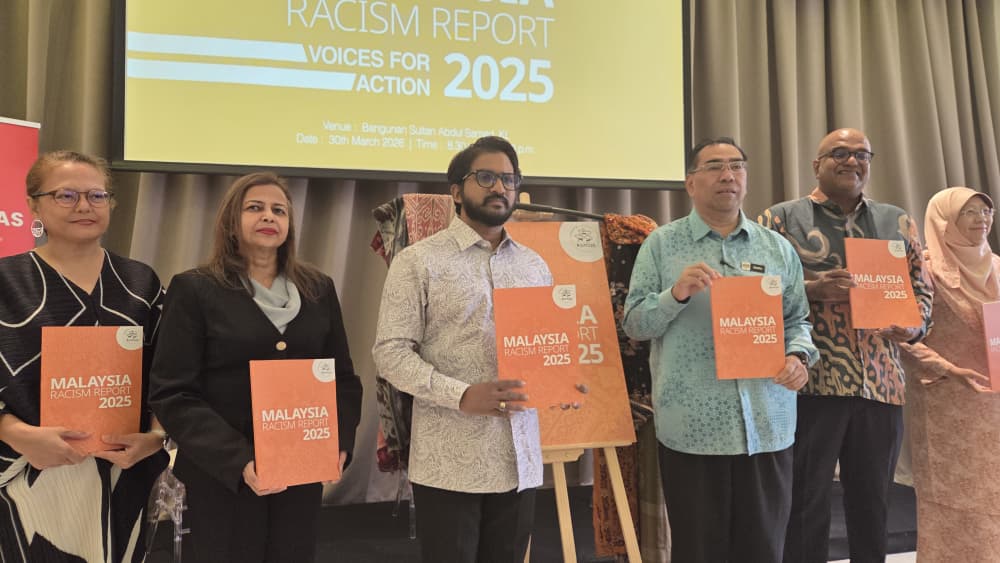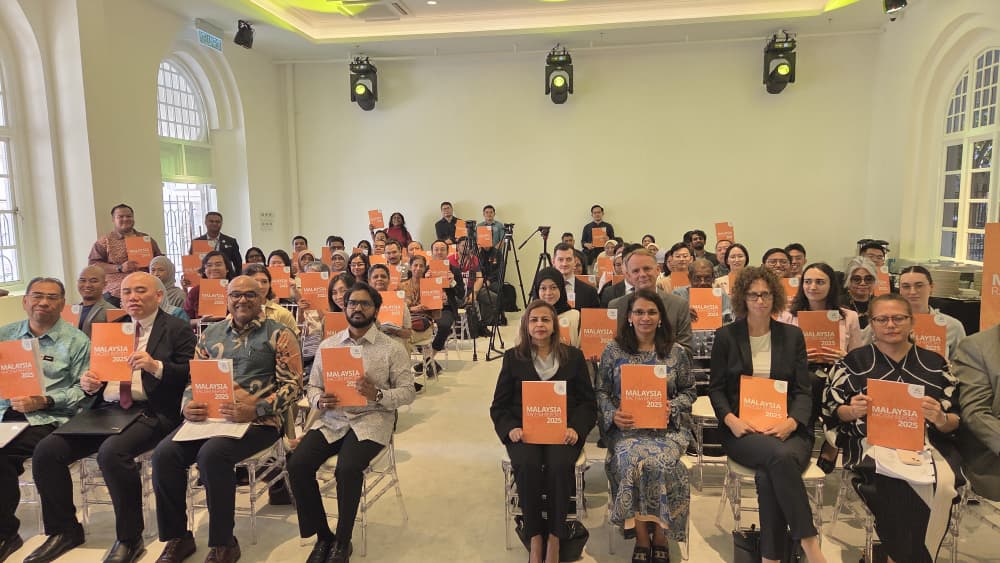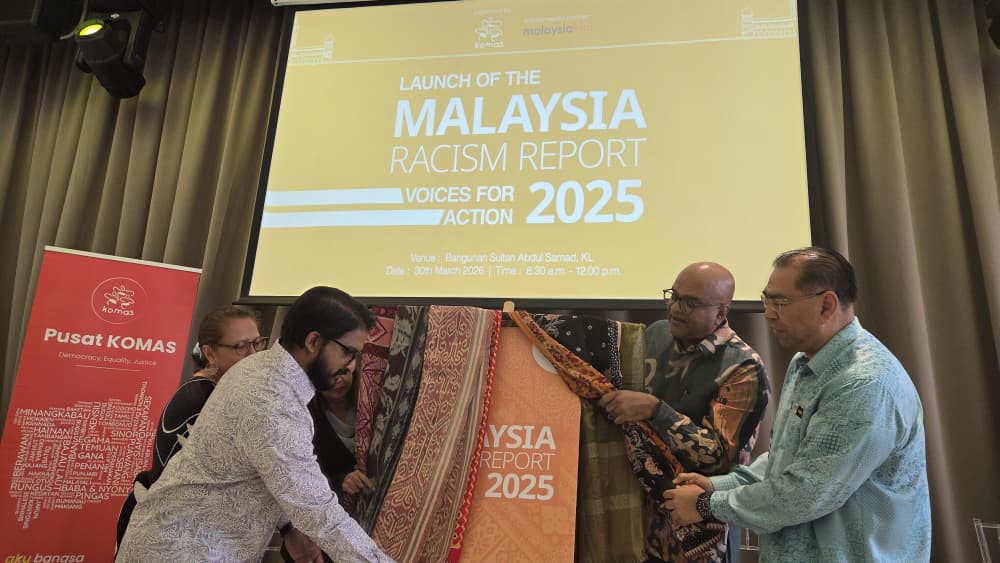
Pusat KOMAS today officially launched the Malaysia Racism Report 2025, marking the 11th consecutive year of documenting and analysing incidents of racism and racial discrimination across the country. The report presents critical findings that highlight persistent structural challenges, evolving patterns of discrimination, and the urgent need for coordinated national action.
The launch event brought together representatives from government, civil society, diplomatic missions, and the media, underscoring the shared responsibility in addressing racism and strengthening national unity.
In his opening address, Director Jerald Joseph emphasised the importance of sustained documentation and accountability, stating, “This report is not just a compilation of incidents. It is a mirror held up to our society.” He further stressed the need for political will and leadership, urging stakeholders to “be brave enough to rewrite a new chapter for Malaysia, one that moves beyond racial anxieties and political calculations.” He called on politicians to “stop sacrificing a nation only for the political expediency to win power!”
The report documents 107 incidents of racism in 2025, the highest number recorded since the report’s inception, reflecting both increased visibility and persistent systemic issues . These incidents span across three main areas: social settings, public discourse and policy, and Parliament, demonstrating that racism is deeply embedded across multiple layers of Malaysian society.
Among the key highlights of the report are:
- Rising Incidents and Structural Patterns
A total of 107 cases were recorded, with a significant concentration in public discourse and parliamentary spaces, indicating the growing role of rhetoric and institutional narratives in shaping racial tensions. - Parliament as a Key Site of Racialised Discourse
Parliament accounted for 43 cases (40.2%), largely driven by racial majoritarian narratives, xenophobic rhetoric, and religious fearmongering, highlighting the responsibility of elected representatives in shaping inclusive discourse. - Everyday Discrimination Remains Widespread
Incidents in workplaces, education, and housing demonstrate that racism continues to affect ordinary Malaysians in daily life, often in less visible but deeply impactful ways.
Speaking on behalf of the KOMAS team, Yogavelan Balamurli noted that the findings reinforce long-standing concerns about systemic gaps:
“The persistence of these incidents shows that racism in Malaysia is not isolated — it is structural, reproduced through policies, narratives, and everyday practices. Addressing it requires more than acknowledgment; it demands sustained institutional reform and public accountability. Reporting racism in a social context maybe be challenging to quantify unlike Parliament we have the Hansard to refer to an quantify. Incidents outside parliament, however, are classified under prejudice and provocation or incitement – where calling out a specific groups could lead to hostile actions such as rallies or even violence targeting them, which can be seen manifesting in 2026 based off utterances in 2025. Additionally, provocation using the struggle for Palestinian freedom, was invoked to stir fear within the Malay community, framed around the loss of influence, power, and position in Malaysia.”
At the launch, Deputy Minister of National Unity, YB Tuan Yuneswaran A/L Ramaraj, acknowledged the complexity of addressing racism in Malaysia, stating, “it only takes a few difficult moments to affect the trust that has been built over generations. At times, narratives that amplify misunderstanding and division may overshadow the values of mutual respect and shared identity that we hold dear.” He further emphasised the broader national responsibility, adding, “Politicians and Members of Parliament must take greater responsibility to lower the temperature when the fires of racism flare. The findings of this report serve as an important reminder that efforts to strengthen unity must be continuous, inclusive, and forward-looking. The recommendations presented are thoughtful and constructive. Some call for coordinated efforts across institutions, while others encourage broader societal participation.”
The Deputy Minister also noted that majority of the hate comments on social media were AI generated. He reaffirmed the government’s commitment to policy reform, including exploring proposals such as the establishment of an Independent Harmony Commission and advancing needs-based approaches under the MADANI framework. This has been a consistent call by Pusat Komas since 8 years ago and we are ready to ensure the setup must be based on international best practise with an independent and empowered commission.
In response to the report’s Special Analysis of the MADANI Government’s 2026 Budget, Nurul Afrina highlighted the importance of equitable resource allocation:
“The budget reflects a gradual shift towards needs-based policy, but gaps remain in ensuring that marginalised communities are not left behind. Fiscal commitments must translate into measurable outcomes that advance equality and reduce structural discrimination. We are not denying the Bumiputera policies; a dual structure of equality and equity are useful guidelines to apply according to different needs for example, need-based allocation should be default universal services, but when it is needed, time-bound affirmative action measures are justified within the correct implementation of its principles.”
The Malaysia Racism Report 2025 is grounded in a human rights–based framework and draws from media monitoring, official records, and verified public reports. It does not seek to assign blame, but rather to encourage constructive engagement and evidence-based reform.
Pusat KOMAS reiterates that the report is ultimately a call to action. As highlighted during the launch, documentation alone is insufficient without meaningful follow-through. Stakeholders across government, civil society, and the public must work collaboratively to address systemic shortcomings and strengthen protections against discrimination.
As Malaysia approaches seven decades of nationhood, the findings of this report serve as a timely reminder: building a just, inclusive, and united society requires courage, honesty, and sustained commitment.