
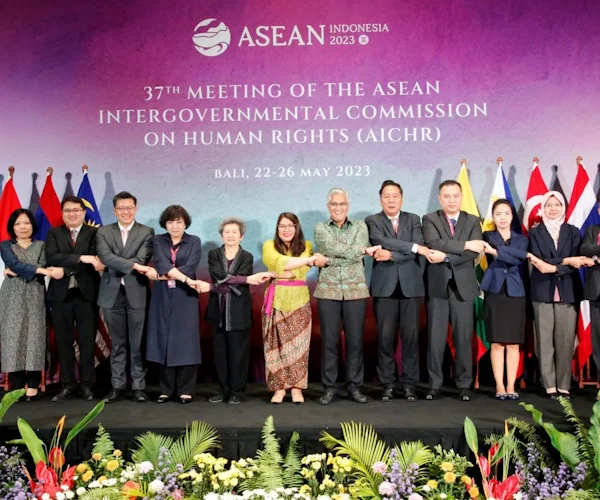
Joint Statement delivered by the CSOs with Consultative Status with AICHR on the 37th AICHR Meeting
26 May 2023, Bali, Indonesia
We, the civil society organisations (CSOs) with consultative status with the ASEAN Intergovernmental Commission on Human Rights (AICHR), extend our sincere appreciation to the Chair of AICHR, H.E. Yuyun Wahyuningrum and excellencies representatives of ASEAN Member States to AICHR. We commend the space and opportunity provided to engage in a dialogue with civil society representatives, which reflects AICHR’s commitment to enhancing communication, coordination, and meaningful engagement with the accredited CSOs. In line with this, we would like to submit our observations and recommendations to strengthen the promotion and protection of human rights in the region. We kindly request the inclusion of this statement in the official summary record.
Excellencies, we express deep concern over the deteriorating situation in ASEAN, marked by the shrinking civic space and the alarming use of repressive laws to harass and intimidate those who defend human rights, including environmental human rights defenders, women human rights defenders, journalists, among others. Further, the ongoing human rights and humanitarian crises in Myanmar is a source of great sadness, with its devastating impact on countless lives and the stability of ASEAN. Additionally, we are alarmed by the persistent exclusion of marginalised groups, including indigenous peoples, LGBTIQ, refugee and asylum seekers, migrant workers, persons with disabilities, to name a few, denying them from enjoying their human rights. These issues pose significant challenges to achieving a peaceful and inclusive ASEAN community.
In light of the prevailing circumstances, we have closely observed the initiatives undertaken by the AICHR, particularly the implementation of its Five-Year Work Plan 2021-2025 (FYWP), to address the pressing human rights concerns. During our discussion, we acknowledge the commendable efforts by AICHR. Nevertheless, we would like to propose several recommendations aimed at improving the implementation of the work plan and fostering productive collaboration between AICHR and the accredited CSOs.
Recommendation to improve AICHR as an institution
While recognising the comprehensive coverage of issues in the FYWP, we suggest that AICHR considers a more targeted approach. By prioritising key areas of concern, the AICHR can focus its resources and efforts to achieve tangible and measurable outcomes. This approach will enable AICHR to effectively address the most critical human rights challenges and maximise its impact.
We commend AICHR for its valuable contributions in fostering multi-stakeholder discussions on a wide range of human rights issues through its activities. However, we believe that it is crucial for AICHR to develop a robust mechanism to effectively measure its impact on human rights situations on the ground. In this regard, we propose that AICHR leverages its existing relationship with CSOs not only to monitor its impact but also to strengthen and expand its work.
Recognizing the invaluable contributions and expertise of civil society organisations, we suggest AICHR establish a structured and inclusive mechanism for CSOs involvement in the implementation and monitoring of the work plan. Regular consultations, dialogue sessions, and joint initiatives can enhance the effectiveness and legitimacy of AICHR’s efforts, ensuring that diverse perspectives are considered and acted upon. Children are an important and significant stakeholder as well, so it would be a good idea to develop and disseminate widely a child-friendly version of ASEAN documents, including the ASEAN Human Rights Declaration (AHRD), that will be made available in all the ASEAN languages.
By actively engaging with CSOs and establishing a collaborative monitoring framework, AICHR can assess the outcomes and effectiveness of its initiatives more comprehensively. CSOs, given their closer proximity to communities and their expertise in various human rights issues, can provide valuable insights that can contribute to a more accurate evaluation of AICHR’s impact. This collaboration will enhance AICHR’s ability to measure the tangible outcomes of its activities and identify areas for improvement.
Further, we appreciate AICHR’s increasing engagement with the National Human Rights Institution (NHRI), which are AICHR’s natural partner at the national level. We recommend each AICHR representative to strengthen their collaboration with its NHRI, where relevant. NHRI can amplify the implementation of AICHR’s commitments at the national level. Together with CSOs and NHRI, AICHR can enhance people’s awareness on ASEAN and its human rights mechanisms.
In addition, we would like to initiate a discussion with AICHR regarding the improvement of its complaint mechanism. We viewed that the existing mechanism lacks accessible information, transparency and accountability, particularly on how to obtain responses and follow-up with the relevant AICHR representatives. Therefore, we call on the AICHR to be transparent in providing information related to the numbers of complaints received and its status. Further, enhancing the complaint mechanism through a right to a formal opinion from AICHR on the merits of the complaint will greatly assist civil society organisations in effectively enforcing ASEAN human rights obligations at the national level. Even if the response to complaints was only advisory, it can significantly contribute to the improvement of human rights standards in the region.
Lastly, we also call for AICHR to be more active in re-purposing the existing frameworks of ASEAN in the context of the ongoing efforts for the High-Level Test Force on ASEAN Post 2025 Community Vision (HLTF-ACV) review work, particularly in ensuring that the agenda of human rights protection is reflected in the vision, and ASEAN will not be silent in confronting massive human rights violations in the region.
We urge immediate steps to be taken, collectively with civil society organisations across the region, towards the implementation and monitoring of our recommendations.
Recommendation on relevant issues
Shrinking civic space
As an institution that has initially recognized the value and the role of civil societies as shown in the ASEAN Socio-Cultural Community (ASCC) blueprint, the facts keep showing, room for civil society in ASEAN to voice concerns has always been limited and shrunk. Based on KontraS’ Human Rights Report 2021, 25 events of violation of civil liberties were compiled in Indonesia and 152 occurred in 2022. Ahead of the 42nd ASEAN Summit in Labuhan Bajo, for example, the Indonesian Police summoned two residents, Dominikus Safio and Viktor Frumentius, over a planned protest regarding compensation for houses and land clearing for a road project. This incident adds to unresolved violence against civil liberties in Indonesia, including criminalising human rights defenders Fatia Maulidiyanti and Haris Azhar where they unpacked the involvement of the Minister of Maritime and Investment Affairs Luhut Binsar Panjaitan in the Papua mining sector. The significant rise of numbers and ways of the government to criminalise human rights defenders and civilians in general through their legal framework are also relevant to what is currently happening to several countries in ASEAN. On 11 April, in Myanmar, the junta military regime launched the deadliest airstrike on civilians, killing at least 170 people when celebrating the opening of a community hall. We also see a continuing crackdown on democracy in Cambodia, where the government shut down independent media, or the mysterious death of Lao activist Bounsuan Kitiyano whose body was discovered on 17 May 2023.
The background showcases one of the issues written in the ASEAN Human Rights Declaration to protect fundamental freedom, and freedom of speech is one of them. With this, we wish for the AICHR to give more exposure or injections to the stakeholders involved in the current work plan for this specific theme, the shrinking civic space. The mainstream of the term itself could start by analysing how the legal frameworks from each ASEAN Member States restrict the freedom of expression and opinion to its civilians with various forms and to have constructive dialogue among the stakeholders.
Civil and Political Rights
Civil & political rights remain largely subordinated in the region. In Malaysia, for example, the Federal Constitution of Malaysia grants Malaysians civil rights, including the right to a fair trial. However, Article 149 allows the government to suspend these rights to combat subversion, violence, and crimes harmful to the public. As a result, laws permitting detention without trial, such as the Security Offences (Special Measures) Act 2012 (SOSMA), Prevention of Crime Act (POCA), Prevention of Terrorism Act (POTA), and Dangerous Drugs (Special Preventive Measures) Act 1985 (DDA), are unlikely to be challenged for violating it. In the meantime, progress in the fundamental freedom of expression and freedom of assembly remains stagnant. Whilst the Pakatan Harapan coalition committed to repealing broadly-worded draconian laws namely the Sedition Act 1948, Printing Presses & Publications Act 1984, and Section 233 of the Communications & Multimedia Act 1998 in their election manifesto, this pledge was backtracked by the unity government for the first two legislations. At the same time, these laws are continuously used to investigate or prosecute those who engage with ‘sensitive’ issues, with one of the most recent instances in the form of a raid of rainbow-colored watches in 11 Swatch stores nationwide by the Home Ministry under the Printing Presses & Publications Act 1984 due to ‘LGBT associations’. Investigations by law enforcement of activists and civilians for organising or participating in public assemblies despite having adhered to the 5-day notice period requirement are still carried out, such as the case with the Women’s March in March 2023.
To address the subordination of civil and political rights in the ASEAN region, the following actions are recommended. Firstly, the AICHR should advocate for legislative reforms, urging all ASEAN countries to amend provisions that restrict freedom of expression and assembly, aligning them with international standards. Secondly, support should be provided for the review and abolition of draconian laws such as the Sedition Act and Printing Presses Act, which have been used to suppress dissenting voices. Lastly, promote accountability and transparency by calling for fair trials and clear justifications for arrests related to sensitive issues or public assemblies.
Right of Persons with Disabilities
AICHR must support the completion of the MTR and the ongoing implementation of the ASEAN Enabling Masterplan 2025 by establishing close coordination with other relevant sectoral bodies and creating a platform for cross-sectoral consultation to promote the human rights approach on addressing issues related to persons with disabilities. Further, AICHR must consider adding more disability mainstreaming activities into the institutional work plan to strengthen the awareness of the ASEAN Sectoral Bodies and stakeholders toward disability rights. AICHR must ensure that all activities should be made accessible for everyone. AICHR must also conduct an assessment to understand the effectiveness of AICHR-hosted disability-related activities to the fulfilment and protection of rights of persons with disabilities, involving the participation of the representatives from the organisation of persons with disabilities. Lastly, following up the recommendations made by the OPDs during the ASEAN-EU Human Rights Dialogue in 2022, AICHR must conduct activities to increase the knowledge and capacity of OPDs and disability activists on human rights. 5. Related to PA 5.1.2 Development of accessible information on AICHR, AHRD and the Phnom Penh Statement, please add that the information should be accessible to the persons with disabilities in accordance with Web Content Accessibility Guidelines (WCAG).
Right to a Healthy Environment and Climate Change
Southeast Asia is one of the most vulnerable sub-regions to climate change impacts. Its population of over 600 million people faces risks such as extreme weather events, rising sea levels, loss of biodiversity, and disruption of livelihoods. Climate change acts as a threat multiplier exacerbating existing vulnerabilities and further marginalising those who are in subordinate positions. It is essential for AICHR, as the overarching human rights body of ASEAN, to actively engage in the development of policies and practices within ASEAN that reaffirm, clarify, and expand the right to a healthy environment in the face of climate change. AICHR can also encourage member states to conduct human rights impact assessments of climate change policies and projects. These assessments would help identify potential adverse impacts on the right to a healthy environment, livelihoods, indigenous peoples’ rights, and marginalised communities. By providing guidance and support for conducting such assessments, AICHR can ensure that human rights considerations are integrated into climate change decision-making processes. CSOs can engage in dialogue with AICHR and member states to ensure that these assessments are comprehensive, participatory, and effectively integrate human rights considerations.
It is very encouraging to learn about the progress of the development of the framework on environmental rights. AICHR, with the support of CSOs, can initiate the discussion to operationalize the right to a healthy environment in the context of ASEAN. CSOs with consultative status with AICHR have already been working extensively on this issue and possess valuable insights that can greatly contribute to the efforts of AICHR.
Racial Discrimination
Minorities in ASEAN continue to suffer discrimination in the countries despite constitutional guarantees. Examples of racism and religious bigotry continue to be a burden on the building of modern, inclusive and mature democracies. In line with AICHR 5 years work plan, AHRD utilises the language of UDHR standard and international treaties. As such we call for more inclusive laws on anti racism / equality to stem this regression suffered by the minorities.
Indigenous Land Rights
As AICHR is committed to its action plan on Business in Human Right, we would like to bring to your attention the continuous discrimination towards the Indigenous community when their ancestral land is taken for development without proper processes, FPIC is seldom done in a proper consultative manner with the communities involved directly. Many times as recorded by the communities themselves, the clarity of the content of engagement by stakeholders if either done without honest consultation and rightful reimbursements (if and when approved by the community). The laws that govern the Indigenous peoples especially in Malaysia are old and need to be reformed, but there is little appetite by the government. We hope AICHR at national level will be able to have intervention with the government to protect Indigenous people of the land and cultural practices.
Situation of Refugee and Asylum Seeker
Despite the continued persecution of ethnic minorities and the escalating humanitarian crisis in Myanmar, those seeking asylum in other ASEAN countries continue to be excluded in the ASEAN human rights discourse. Many, including women and children, are unable to access the fundamental right to seek asylum as member states continue to push back boats, subject them to indefinite detention and/or deport them to Myanmar in breach of non-refoulement. These actions are contrary to customary international law, Universal Declaration of Human Rights ,the Convention on the Rights of the Child, the ASEAN Human Rights Declaration and ASEAN Declaration on the Rights of Children in the Context of Migration. We urge AICHR to include these critical human rights issues into their agenda to be able to hold member states accountable to their human rights commitments.
Women Migrant Workers
The ASEAN countries within the region are both sending and receiving countries. With this, we are appealing to the ASEAN Member States, through the AICHR, to uphold the basic rights and welfare of our women migrant workers. Among them are the ratifications of ILO Conventions, particularly on Decent Work for Domestic Workers (ILO C 189) and Ethical Recruitment of Migrant Workers (ILO C 181). Also, the translation of the ratified conventions to local laws and strict implementation of policies and bilateral/multilateral agreements.
AICHR can play a key role in promoting safe labour migration pathways within the region, and encouraging all ASEAN Member States to respect the rights of all migrant workers without discrimination.
—- End —-
This submission was drafted collectively based on the input from a consultation among AICHR’s accredited CSOs in the preparation of the AICHR-CSO Interface Meeting in the 37th AICHR Meeting on 25th May 2023. Those who attended the consultation:
Asian Forum for Human Rights and Development (FORUM-ASIA), Raoul Wallenberg Institute of Human Rights and Humanitarian Law, Child Rights Coalition Asia, SUARAM, Pusat Komas, Perkumpulan Penyandang Disabilitas Indonesia, ASEAN Employees Services Trade Union Council (ASETUC), Philippine Migrants Rights Watch (PMRW), Development Action for Women Network (DAWN), Global Alliance against Traffic in Women (GAATW), Asylum Access Malaysia (AAM); and Human Rights and Development Foundation (HRDF).